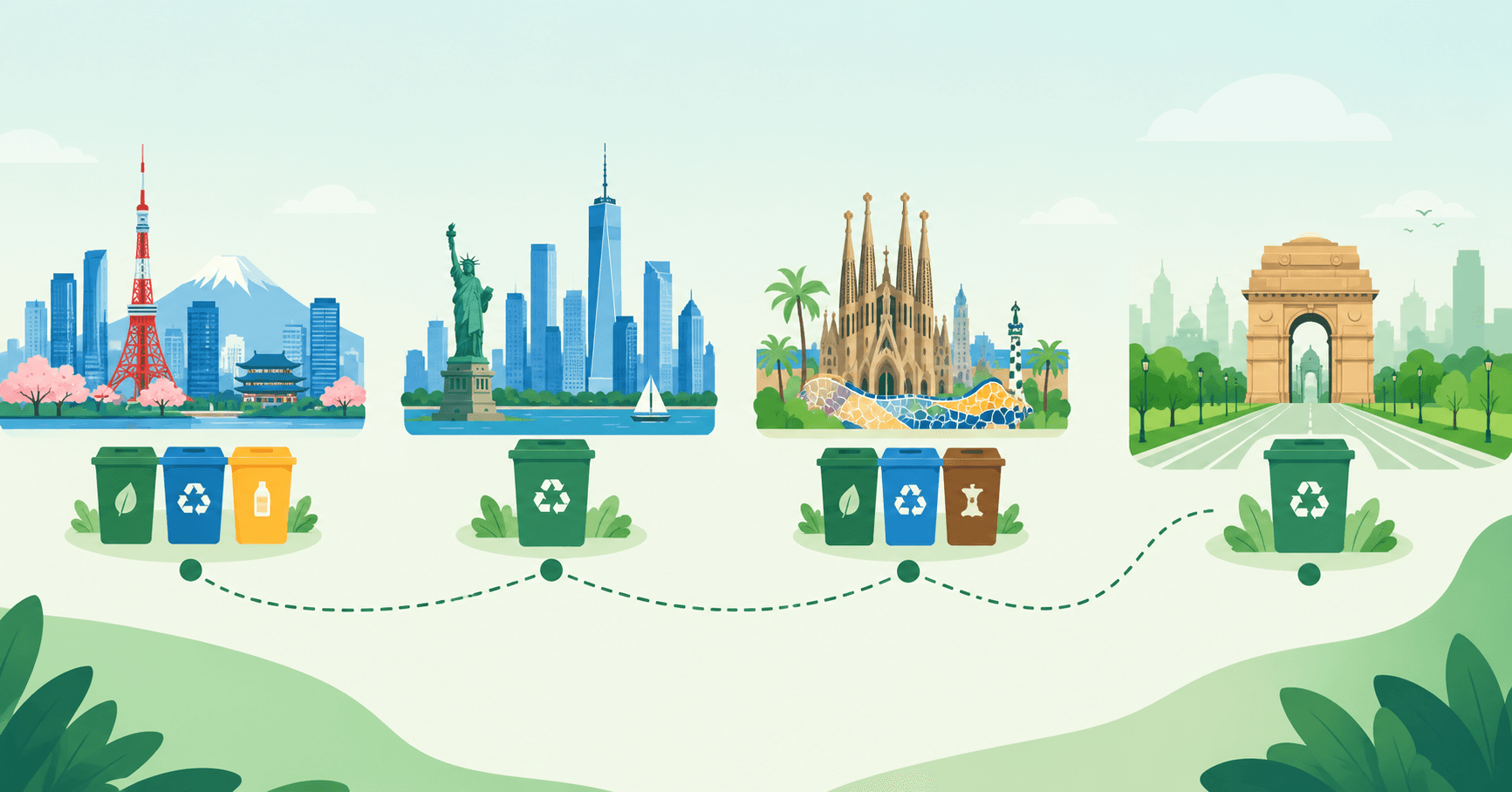
Delhi's Municipal Corporation (MCD) has announced it will study how three of the world's biggest cities — Tokyo, New York, and Barcelona — manage their waste, with an eye on adapting parts of those systems for the capital. It's a rare moment: instead of another rulebook update, this is Delhi openly admitting that other cities are doing this better, and asking how.
That's worth paying attention to. Not because a study trip changes anything overnight, but because it tells you where the city is likely headed next — and if you live in Delhi NCR, that direction will eventually show up at your own doorstep.
Why Look Outside India at All?
Delhi generates thousands of tonnes of waste every single day, and a large share of it still ends up mixed, poorly processed, or piled onto landfills like Bhalswa, Ghazipur, and Okhla. The Solid Waste Management Rules, 2026 were meant to fix this from the policy side — stricter segregation, digital tracking, and real penalties for mixed waste. But rules on paper only work if the systems underneath them can deliver.
Green Fact
Delhi's waste still ends up mixed, poorly processed, or piled onto landfills like Bhalswa, Ghazipur, and Okhla far too often. The 2026 Rules set the legal standard — MCD's global study is about closing the gap between that standard and what actually happens on the ground.
That's exactly where Tokyo, New York, and Barcelona come in. Each has spent decades solving the same basic problem Delhi faces now — too much waste, too little segregation, not enough capacity — just with very different methods.
3
global cities MCD is studying: Tokyo, New York, Barcelona
4
mandatory waste streams under India's SWM Rules 2026
What Each City Actually Does
Tokyo runs one of the most disciplined household segregation systems in the world. Residents sort waste into many separate categories, collection happens on fixed days for each category, and non-compliant waste is often simply left uncollected until it's sorted correctly. The system leans heavily on citizen habit and predictable scheduling — not on chasing people down.
New York has invested heavily in curbside organics collection (separating food waste for composting) and is rolling out containerized collection to get rid of loose garbage bags piled on sidewalks — partly to tackle rats, partly to make trucks more efficient.
Barcelona is known for its "door-to-door" and smart-bin systems in different neighbourhoods, using sensors and access-controlled bins to track who's disposing what, which helps both enforcement and recycling rates.
The common thread across all three: consistency and predictability for the resident, paired with real consequences for not segregating.
Think you've got a handle on why these global models actually work? Test yourself below.
Test what you just learned
A quick check before you continue reading.
Card 1 of 3
What This Could Mean for Delhi NCR
It's too early to know exactly which pieces MCD will borrow, but a few likely directions stand out:
- Fixed collection schedules by waste type, similar to Tokyo, rather than the "whenever the truck shows up" model many neighbourhoods still deal with.
- Better organics handling, since wet waste is the hardest part of India's waste stream to manage and the biggest reason waste-to-energy plants struggle here.
- Smarter tracking at the bin or household level, which lines up with the centralised digital tracking dashboard already planned under the 2026 Rules.
None of this happens overnight in a city the size of Delhi. But the direction of travel is clear: less "collect and dump," more scheduled, tracked, segregated pickup — which, frankly, is the model doorstep services like Green3r are already built around.
The Real Bottleneck Isn't the Idea — It's Habit
Tip
Tokyo's system doesn't work because of clever trucks or good policy alone. It works because sorting waste correctly is just what people do there, every day, without thinking about it — the habit came before the technology.
Here's the part that often gets missed in these comparisons: Tokyo's system doesn't work because of clever trucks or good policy alone. It works because sorting waste correctly is just... what people do there, every day, without thinking about it. That's the actual gap in most Indian cities — not the lack of good ideas, but the lack of consistent habit at the household level.
We wrote about this a while back — segregation at source really is the one habit that changes everything downstream. Every city on this list figured that out before they figured out the technology.
What You Can Do Right Now
You don't need to wait for MCD's global study tour to finish. The core habit those cities rely on — clean, correct segregation at the source — is something you can start today, and it's exactly what a scheduled doorstep pickup is designed to make easy.
Delhi doesn't need to wait for a finished blueprint from Tokyo, New York, or Barcelona to start closing the gap. The habit those cities rely on can start at your door today.
🌱 Green3r App
Start the habit these cities already have — schedule your first Green3r pickup
Download on iOS & Android · Delhi NCR & nearby cities