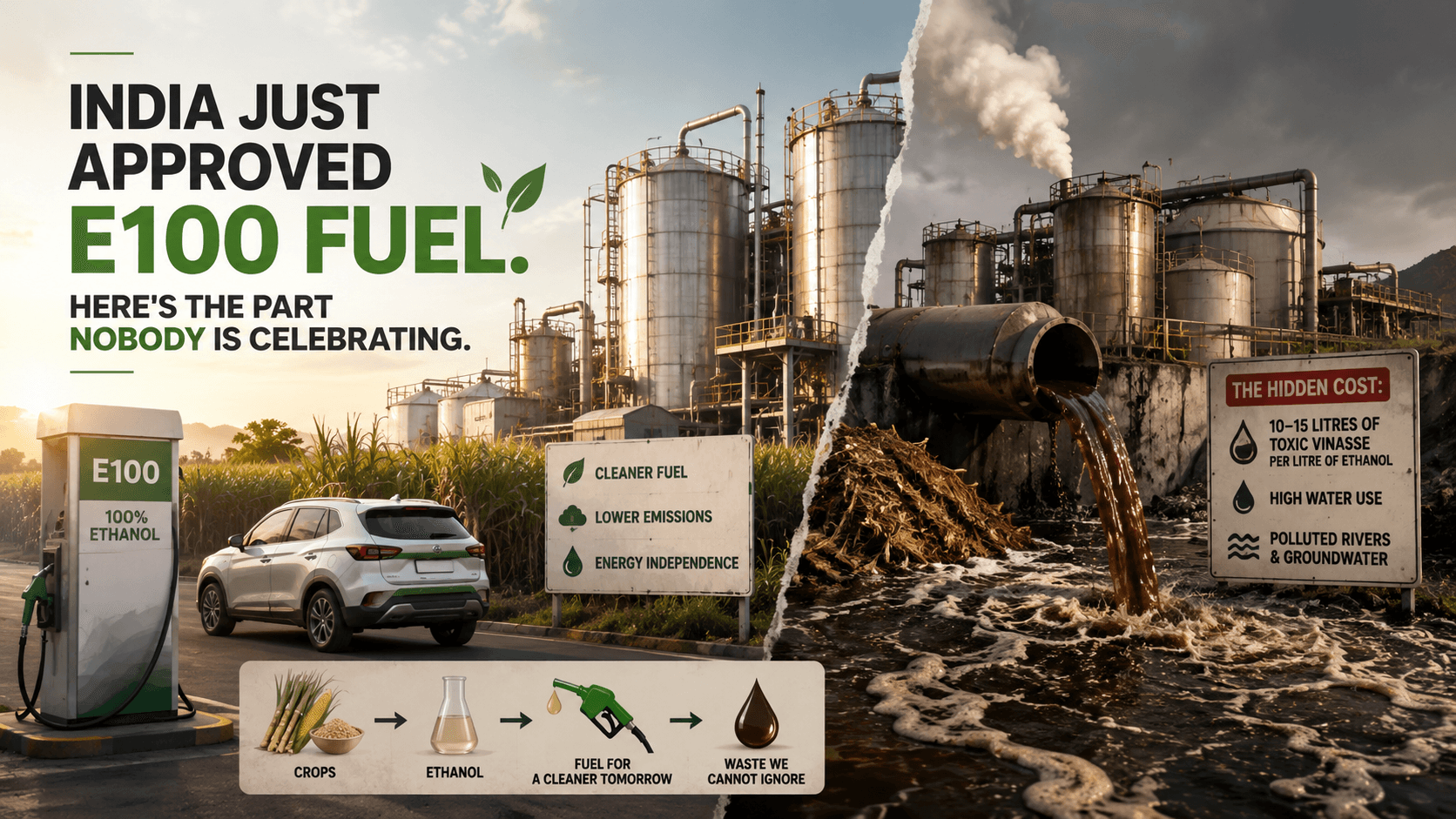
On June 13, 2026, Union Minister Nitin Gadkari signed the final authorisation files in Nagpur at 8:00 PM. With that, India became one of the few countries in the world to formally legalise 100% ethanol as a commercial automotive fuel.
The headlines wrote themselves. Clean fuel. Energy independence. Farmers benefiting. Import bills shrinking. Maruti's WagonR already flex-fuel ready. Toyota's Innova next in line. Four hundred ethanol pumps live today, five thousand planned by end of 2027.
It is genuinely significant policy. India met its E20 blending target ahead of schedule, and E100 is the logical next step in a direction the country has been building toward for years.
But here is what is not in the headlines.
Ethanol — the same molecule that will power your next car — is one of the most resource-intensive liquids India produces. And the waste it generates on the way to your fuel tank follows the same pattern as every other environmental problem this country is still solving: the costs fall downstream, quietly, while the benefits get announced loudly.
What ethanol actually is, and where India's comes from
Fuel-grade ethanol is not a new invention. It is grain alcohol — the same compound found in every alcoholic beverage — produced at industrial scale through fermentation. Sugarcane juice, molasses, broken rice grains, and maize are the primary feedstocks in India. Yeast converts the sugars into ethanol and CO₂. Fractional distillation concentrates it. Molecular sieves dry it to above 99.5% purity. The result is anhydrous ethanol — clear, volatile, and ready to blend with petrol or, under the new rules, run a vehicle entirely on its own.
India's E20 success — 20% ethanol blended into standard petrol, achieved ahead of the original 2025 deadline — was built largely on sugarcane surplus from Maharashtra and Uttar Pradesh, and on grain diversion from rice and maize stocks. The E100 ambition requires significantly more of the same.
That is where the math starts getting uncomfortable.
The water cost that does not fit in a press release
Producing one litre of fuel-grade ethanol requires water. Quite a lot of it, depending on what crop you start with.
For sugarcane — India's dominant ethanol feedstock — the full lifecycle water requirement runs between 2,860 and 3,630 litres per litre of ethanol produced. For maize, it is approximately 4,670 litres. For rice, the crop that several Indian states are actively diverting into the ethanol supply chain, it is 10,790 litres per litre of fuel.
2,860–3,630 L
water per litre of ethanol from sugarcane
4,670 L
water per litre of ethanol from maize
10,790 L
water per litre of ethanol from rice
To put that in terms of a full tank: filling a 40-litre flex-fuel vehicle on pure E100 from rice-derived ethanol requires the water equivalent of roughly 4.3 lakh litres — a number that should give pause to anyone thinking seriously about where India's water table is headed over the next decade.
Green Fact
India is already among the world's most water-stressed large economies. The Central Ground Water Board classifies over 16% of India's assessment units as overexploited. Scaling ethanol production from water-intensive crops like rice compounds a problem that is already critical in several key agricultural states.
This is not an argument against ethanol. It is an argument for being clear-eyed about what the transition actually costs, and where those costs fall.
The waste no one is photographing
For every litre of ethanol produced, the distillery generates 10 to 15 litres of vinasse — also called spent wash. It is a dark, highly acidic, oxygen-depleting liquid effluent. Left untreated, it destroys aquatic ecosystems. A single distillery releasing vinasse into a local water body can eliminate fish populations and render the water unusable for irrigation within days.
India's Central Pollution Control Board (CPCB) knows this. The regulatory response is Zero Liquid Discharge — ZLD — a mandatory engineering standard requiring every grain or molasses distillery to process 100% of its effluent through closed-loop systems before receiving operating clearance.
The technology exists and works. Multi-effect evaporators boil down vinasse into a thick slurry. Condensate polishing units recover the water for reuse. The remaining organic solid either goes into boilers alongside sugarcane bagasse to generate electricity, or gets composted into agricultural fertiliser. Done correctly, it is a genuinely circular system.
Done incorrectly — or not monitored — it is a catastrophe waiting downstream.
Tip
ZLD certification requires 30 consecutive days of verified operational data submitted to CPCB. Plants must also run Online Continuous Effluent Monitoring Systems, streaming real-time data directly to government servers. Distilleries that fail compliance lose central government pricing incentives, interest subventions, and fuel procurement allocations.
The incentive structure is right. But enforcement depends on data quality — and data quality depends on what actually gets reported, not just what gets submitted.
Think you've got a handle on where ethanol's hidden costs actually sit? Test yourself below.
Test what you just learned
A quick check before you continue reading.
Card 1 of 3
The same problem, a different industry
If you have read our earlier piece on waste-to-energy plants in India, this will feel familiar.
WtE plants were built to process segregated dry waste. They receive mixed, wet, contaminated loads instead. Calorific value drops. Emissions rise. Output falls short of design capacity. The infrastructure is sound — the inputs are not.
Ethanol distilleries are built to process clean, high-sugar, high-starch feedstock and output both fuel and managed byproducts within a closed-loop ZLD system. What undermines that system is not the engineering — it is the same upstream failure: what enters the process is not what the process was designed for.
Wet feedstock reduces fermentation yield. Contaminated grain increases vinasse toxicity. And when commercial pressure to maximise fuel output outpaces the capacity of ZLD infrastructure to handle increased effluent loads, the system that was meant to protect local water bodies becomes the first thing cut.
This is not hypothetical. India's distillery expansion over the past three years has repeatedly outpaced ZLD installation timelines. The CPCB has issued notices. Several states have seen localised incidents of vinasse discharge. The regulatory architecture is correct — the implementation gap is real.
Green Fact
India processed approximately 8.9 billion litres of ethanol in the 2023–24 supply year, up from 1.9 billion litres in 2013–14. That is a nearly five-fold increase in a decade. ZLD infrastructure, water consumption, and effluent management have not scaled at the same rate.
The E100 opportunity — if the inputs are clean
Here is where it turns constructive, because the ethanol story is not one that should end in pessimism.
E100 fuel, produced from genuinely surplus feedstock through a properly managed ZLD distillery, does deliver a real emissions benefit. Ethanol combustion in a vehicle produces CO₂ that was absorbed by the crop during growth — a broadly carbon-neutral cycle when the full lifecycle is managed well. The 25–30% mileage reduction compared to petrol is a real trade-off, but at lower fuel cost per kilometre, flex-fuel vehicles can still make economic sense for users, particularly as the pump network scales toward 5,000 outlets by end of 2027.
The E20 milestone — 20% ethanol in standard petrol, achieved ahead of schedule — has already reduced India's crude oil import bill meaningfully. E100 extends that logic. The direction is right.
What determines whether E100 delivers on its promise is not the engine technology or the fuel legislation or even the pump network. It is the quality of what goes into the production chain, and the rigour of what happens to the waste that comes out of it.
That is a sentence that applies equally to a rice paddy supplying a distillery in Uttar Pradesh, and to a household in Delhi NCR deciding whether to separate its wet waste before handing it over for pickup.
The lesson that keeps repeating
India is capable of building ambitious, well-designed environmental systems. The ZLD framework for distilleries is genuinely sophisticated regulation. The SWM Rules 2026 are among the most detailed solid waste governance frameworks in the developing world. The E100 legislation is a serious policy commitment backed by industrial investment.
What these systems share — and what keeps determining whether they work or fall short — is a simple truth: clean outcomes require clean inputs, at every stage, all the way upstream.
For ethanol, that means ZLD compliance without shortcuts, water-efficient feedstock choices, and effluent monitoring that reflects what is actually happening at the plant gate.
For urban waste, it means the same thing it has always meant. Two bins. Separated. Every day.
The infrastructure exists. The policy exists. What bridges them is the behaviour that happens before the system even begins.
India's clean fuel future and India's clean waste future are being built in parallel. Both depend on the same upstream discipline. The household that segregates its waste and the distillery that runs a genuine ZLD system are solving the same problem at different scales — and both matter.
🌱 Green3r App
Two bins, separated, every day - Green3r makes source segregation simple
Download on iOS & Android · Delhi NCR & nearby cities