The next time a Swiggy or Zomato order arrives at your door, the container it came in could - under India's new plastic waste rules - be made from 60% recycled plastic.
That's not a distant possibility. It's a regulatory mandate that came into effect in 2026, under India's updated Plastic Waste Management Rules. And it represents one of the most significant shifts in how the country thinks about the relationship between packaging, waste, and responsibility.
But here's the part that rarely makes headlines: this rule only works if the plastic that goes into the recycling system is clean enough to come back out as food-grade material. And that starts with what you do at home.
What the 60% rule actually means
India's revised Plastic Waste Management Rules now require that rigid food packaging - the kind used for takeaway containers, curd tubs, and similar products - contain a minimum of 60% post-consumer recycled plastic content.
This is a significant jump. Previously, recycled plastic in food-contact applications was heavily restricted due to contamination and safety concerns. The new rules allow it, but with strict conditions: recycled plastic used in food packaging must pass FSSAI's challenge test, which verifies that no chemicals are leaching from the recycled material into the food.
Green Fact
FSSAI's challenge test requires manufacturers to prove that chemicals from recycled plastic do not migrate into food - even when recycled content is as high as 60%.
Mechanical strength is the other requirement. Recycled plastic used for rigid containers must perform at the same standard as virgin plastic - it cannot be brittle, warped, or structurally compromised.
Think food-grade recycled plastic is simple? Test yourself below.
Test what you just learned
A quick check before you continue reading.
Card 1 of 3
How recycled plastic actually gets made
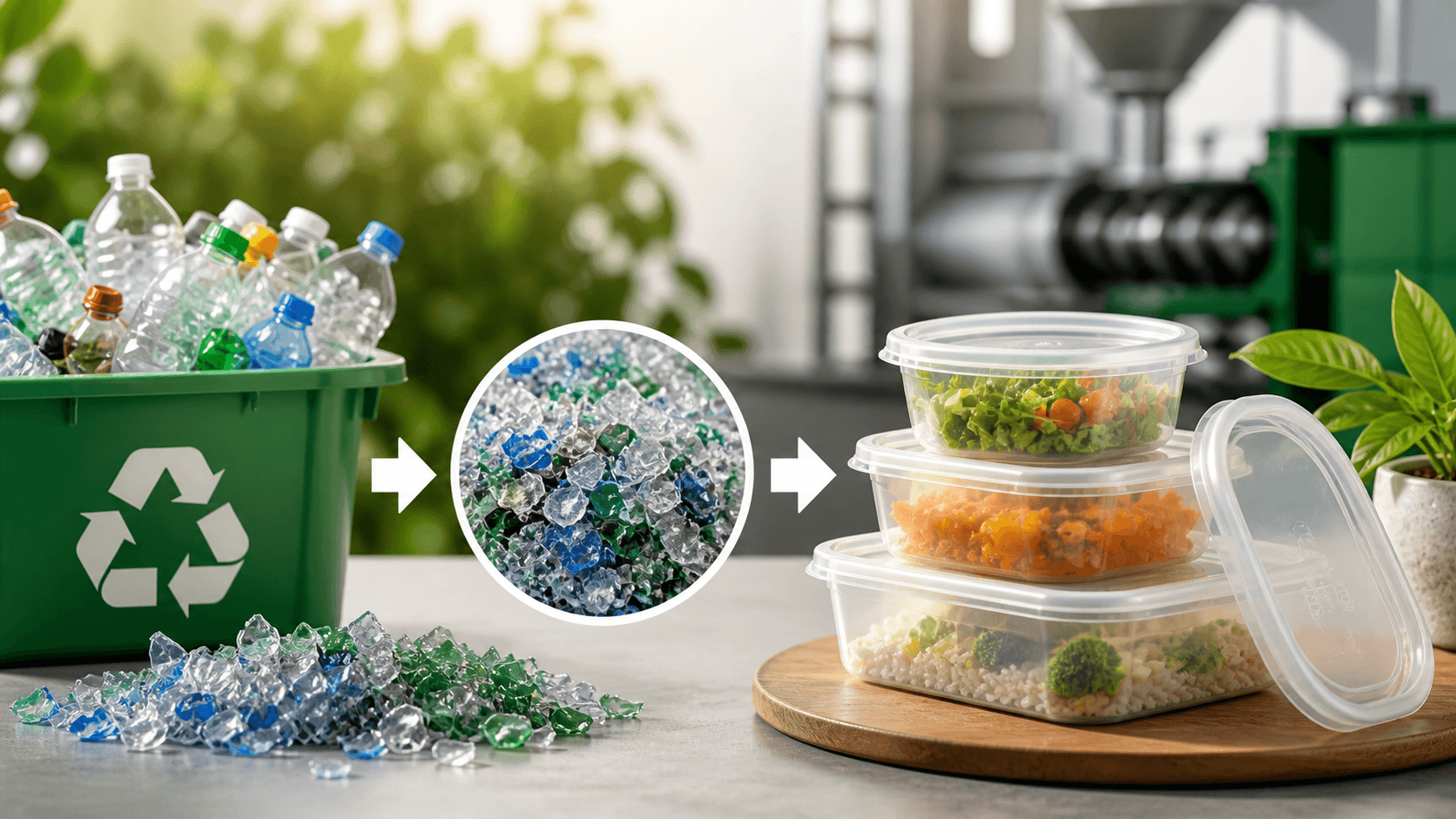
Most people have a vague sense that plastic gets "recycled" - but the actual process is precise, multi-step, and highly sensitive to contamination.
Here's what happens from your bin to a finished container:
Collection and pre-segregation - Plastic must arrive at recycling facilities already sorted by type. Mixing polymer types is a serious problem: a milk pouch is polyethylene, and if it mixes with polystyrene during collection, chemical migration between the two polymers can occur, making both unusable for food-grade applications.
Washing and decontamination - Collected plastic is washed thoroughly to remove food residue, labels, and surface contaminants. This requires significant clean water resources and dedicated infrastructure.
Shredding - Clean plastic is shredded into small flakes. This stage carries its own challenge: shredding generates microplastics, which recycling facilities must manage carefully to prevent environmental release.
Pelletisation - Flakes are converted into pellets through a process that removes volatile compounds. These pellets are the finished raw material - ready to be sold to manufacturers.
Moulding - Pellets are sent to manufacturing units that mould them into finished products: a Swiggy container, a curd tub, a medicine bottle.
60%
recycled content now allowed in rigid food packaging
5
stages from your bin to a new container
95%
less energy used recycling vs virgin plastic
The traceability requirement
One of the less-discussed but important elements of the new rules is traceability. FSSAI now requires recyclers to follow an ISO standard that specifies the percentage of recycled content in a product and makes that information trackable.
In practice, this means a product labelled as containing 60% recycled plastic carries a verifiable record. When that product is itself recycled in the future, the next processor knows the recycled content was already 60% - relevant because plastic degrades slightly with each cycle, and mechanical strength must still meet the required standard.
Tip
Look for recycled content labels on packaging when you shop. Brands that adopt recycled plastic at scale are directly reducing demand for virgin plastic derived from crude oil.
Why segregation at home is the foundation of all of this
Here's the connection that the policy documents don't spell out clearly: none of this works without clean, pre-sorted plastic arriving at recycling facilities.
If a plastic bottle has food residue in it, it contaminates the batch it's sorted into. If different plastic types are mixed during collection, the entire load may be unusable for food-grade applications. If plastic arrives at a facility tangled with wet waste, the decontamination cost rises sharply - and the quality of the output drops.
The 60% mandate is ambitious. Industry insiders acknowledge it will take time for brands and recyclers to fully adapt. But the limiting factor isn't technology or regulation - it's feedstock quality. Clean, segregated plastic is the raw material the entire system depends on.
Green Fact
The Central Pollution Control Board digitally tracks Extended Producer Responsibility (EPR) targets - meaning brands are now legally accountable for the plastic they put into the market and responsible for ensuring it is collected and recycled.
What this means for waste habits in Delhi NCR
The Extended Producer Responsibility framework means brands that sell products in plastic packaging are now responsible for ensuring that packaging gets collected and processed. The CPCB tracks targets digitally. Compliance is no longer optional or self-reported.
But EPR works best when the plastic entering the system is already sorted. A recycler that receives pre-segregated, clean plastic can process it faster, at lower cost, and to a higher quality standard - making food-grade output genuinely achievable.
When you rinse a plastic container before placing it in dry waste, you are not performing a symbolic act. You are improving the feedstock quality for a recycling chain that now has a legal mandate to produce food-grade material from what you send in.
India's 60% recycled plastic rule is bold. Whether it succeeds depends on choices made at thousands of points across the supply chain - in manufacturing, logistics, retail, and regulation. But it also depends on what happens at the very beginning of that chain: the moment a plastic container is rinsed, sorted, and left at the door for pickup.
That part has always been yours.
🌱 Green3r App
Segregate your plastic the right way - Green3r picks it up every morning
Download on iOS & Android · Delhi NCR & nearby cities