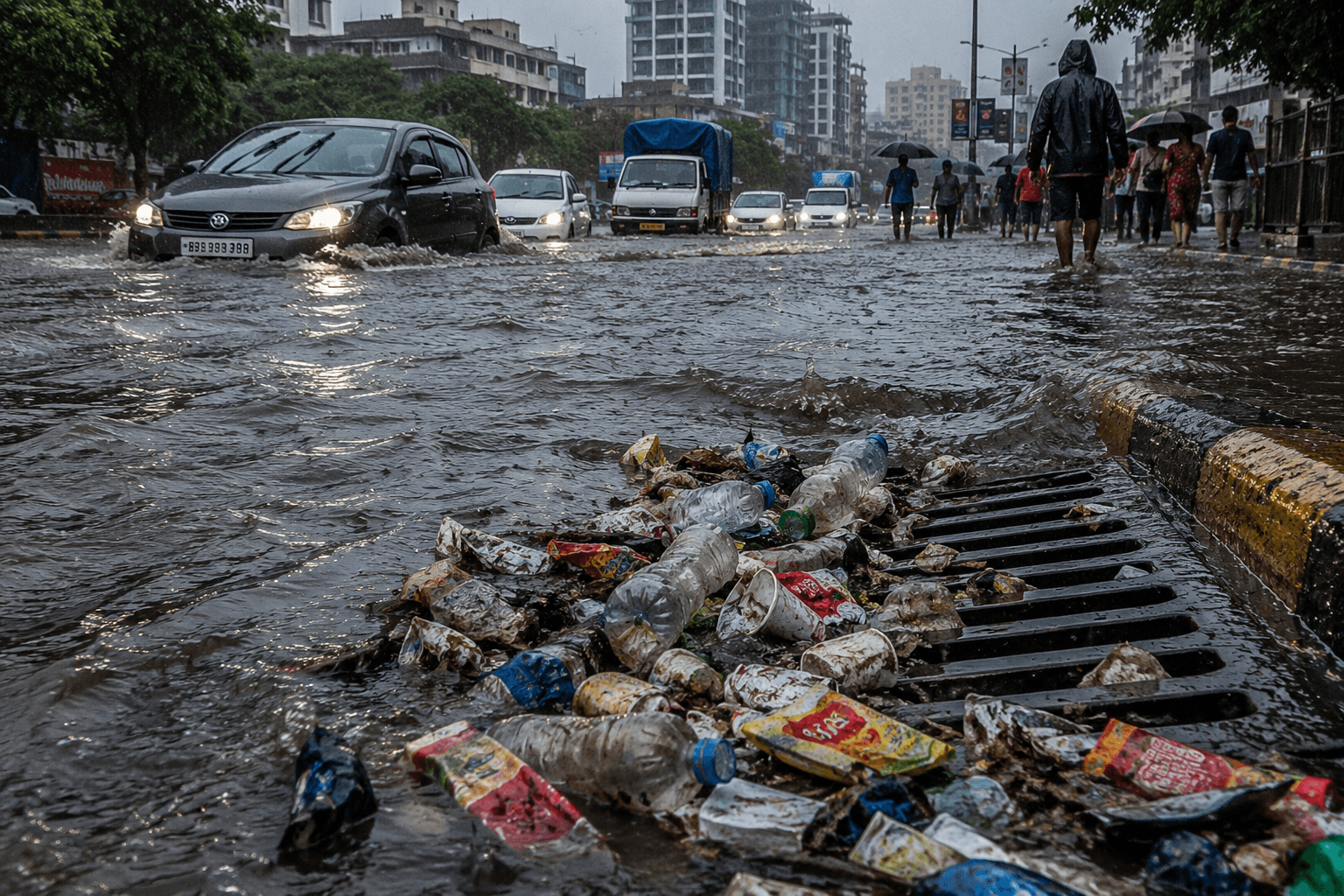
It is July 9, 2026. A school bus is stuck in waist-deep water on a Gurugram road. A section of NH-48 — a national highway — has caved in near Narsinghpur due to water pressure in underground pipelines. Gurugram Police have issued a work-from-home advisory because the city's roads are simply impassable. Delhi's Ridge weather station has recorded 154% excess rainfall this July.
In Mumbai, the BMC is pumping water off arterial roads. In Hyderabad, HYDRAA's emergency teams have pulled out mattresses, sofas, pillows, plastic debris, and two full truckloads of waste from a single box drain that had been clogged for months. In Bengaluru, Chennai, and across the NCR, the story is the same: a few hours of heavy rain, and cities that took decades to build grind to a halt.
Every year, we call it a flood. Every year, we blame the rain.
The rain is not the problem.
What is actually blocking India's drains
Before the monsoon arrived this year, Delhi's civic agencies ran a desilting drive. They mapped vulnerable points, deployed machinery, and cleaned drains across the city. Their own officials noted what they found inside: silt, plastic waste, and construction debris. The same assessment, every year. Officials say the main focus has been on desilting drains before heavy showers begin, with silt, plastic waste and construction debris reducing the carrying capacity of drains — and that even after desilting, drains can choke again if garbage and debris enter them during storms.
In Hyderabad, HYDRAA Commissioner AV Ranganath was direct about what his teams found when they opened the city's storm drains ahead of this monsoon. Operations exposed how indiscriminate dumping of household waste into drains has become one of the primary reasons for recurring urban flooding — with teams removing 13 tipper loads of waste including mattresses, sofas, chairs, pillows, blankets, plastic debris and other discarded household items from a single drainage network.
In Mumbai, experts reviewing decades of infrastructure upgrades reached the same conclusion. Stormwater drains are often choked with plastic waste, mud, construction material and other garbage, preventing the smooth flow of rainwater — and without proper cleaning and maintenance, even an advanced drainage system can struggle to handle intense rainfall.
This is not a monsoon problem. This is a waste problem that the monsoon makes visible.
Green Fact
India generates approximately 1.85 lakh tonnes of solid waste daily. Less than 20% of Indian cities have functional source segregation systems. The rest of that waste — mixed, unsegregated, unmanaged — finds the path of least resistance. That path is usually a drain.
Two failures. One flooded city.
Let's be direct about both.
The citizen failure is littering and the absence of waste segregation. Every plastic bag thrown on a street, every food wrapper dropped near a nullah, every load of mixed garbage dumped near a drain opening is infrastructure sabotage in slow motion. It does not look like sabotage. It looks like one piece of plastic. But multiplied across millions of households, daily, across eleven months of dry weather, it accumulates into the blockages that turn three hours of rain into three days of civic paralysis.
The connection is not complicated. Plastic does not dissolve. It does not compact. It travels with rainwater runoff, enters storm drains, and lodges at bends and junctions. The drain's carrying capacity — the volume of water it can move per hour — drops. When 80mm of rain falls in an afternoon, as it did in Gurugram on July 8, a drain operating at 40% capacity because of waste blockage cannot cope. The water goes somewhere else. It goes onto the road. It goes into your car. It goes into your ground floor.
The government failure is equally real and should not be softened. India's storm drain networks in most cities were designed for population densities and rainfall intensities that no longer reflect reality. Even though the drainage network gets updated often, it is still not fully developed — and in most tier-2 and tier-3 cities, it has not been updated at all. Stormwater and sewage systems share the same pipes in large parts of Delhi, Mumbai, and Bengaluru. When one overflows, both fail.
Delhi's waterlogging problem is also linked to urban pressure — rapid construction, shrinking open spaces, encroachments near drains and waste dumping all affect rainwater flow. Natural water absorption — wetlands, open soil, green cover — has been systematically replaced with concrete. Rain that would have percolated into the ground now has nowhere to go except the drain, which is already blocked.
Both failures are real. But only one of them is within your control today.
Tip
A better drainage network would help. Better pre-monsoon desilting would help. Separate stormwater and sewage lines would help — and are mandated under the SWM Rules 2026. But none of those improvements change what happens when a plastic bag enters a drain. Infrastructure can increase capacity. It cannot overcome constant blockage. Both need to be solved.
The cities that keep flooding — and why
Each city has its own specific failure point, but the pattern is identical everywhere.
Gurugram sits on a natural gradient that should drain water efficiently. Its crisis is infrastructure age and waste. The cave-in on NH-48 occurred on the Delhi-Jaipur carriageway, forcing authorities to divert traffic, with several arterial roads and underpasses submerged — while the municipal corporation's primary focus during heavy rainfall was ensuring speedy drainage and maintaining traffic flow. Reactive management during an active flood event is not a drainage strategy.
Mumbai has spent thousands of crores on the Brihanmumbai Storm Water Disposal System since the catastrophic 2005 floods. Yet every monsoon delivers the same images. For decades, Mumbai's mangroves and wetlands acted as natural safety systems soaking up excess water — but increasing development and encroachment have damaged many of these ecosystems, meaning more rainwater flows directly into the city. Concrete replaced absorption. Waste blocked what drainage remained.
Hyderabad's HYDRAA found a drain near Chandanagar with two truckloads of plastic waste compacted inside a single box drain junction. The Krishna Nagar box drain, which frequently causes flooding due to runoff from Jubilee Hills, was found clogged with nearly seven feet of silt and waste — with a concrete slab covering the drain having prevented routine desilting, significantly reducing its capacity.
Delhi-NCR recorded 154% excess rainfall this July — but excess rainfall in a functional drainage system is manageable. What made it catastrophic was the combination of blocked drains, encroached natural water channels, and years of mixed waste entering storm drainage infrastructure.
The rain was the trigger. The waste was the cause.
154%
excess rainfall recorded at Delhi's Ridge station this July
13
tipper loads of waste pulled from a single Hyderabad drain
7 ft
of silt and waste clogging the Krishna Nagar box drain
Think you've got a handle on why India's cities actually flood? Test yourself below.
Test what you just learned
A quick check before you continue reading.
Card 1 of 3
What actually needs to change
This is where the conversation usually gets vague. "Better infrastructure." "More civic awareness." "Government accountability." These are true and useless without specifics. Here is what specifically needs to happen, at each level:
At the household level — stop waste from entering the system:
The most direct intervention available to any individual is keeping waste out of public spaces and drainage pathways. This means segregated waste that is handed over for collection — not dropped on streets, not pushed toward drains, not left in open piles near nullahs. It means four streams: wet, dry, sanitary, and special-care. Wet waste that is collected and composted does not become the plastic-and-organic sludge that chokes drain junctions. Dry waste that reaches recyclers does not become the floating debris that monsoon runoff carries into storm drains.
This is not a symbolic act. It is a direct physical intervention in what enters the drainage system.
At the collection system level — daily pickup, no gaps:
Waste that is segregated but not collected reverts to the street within hours. The missing link in most Indian cities is not citizen awareness — it is reliable, daily, door-to-door collection that removes waste from the urban surface before rain can mobilise it. Cities that have functioning daily pickup systems do not find sofas in their storm drains.
At the civic infrastructure level — pre-monsoon desilting is not enough:
Annual pre-monsoon cleaning is a band-aid on a system that accumulates blockage year-round. Drains need covered inlets with waste traps, regular inspection schedules, and stormwater systems physically separated from sewage lines. These are engineering requirements, not optional upgrades. The SWM Rules 2026 mandate separate collection and infrastructure — implementation cannot wait for the next monsoon to remind us why.
At the policy level — accountability for waste dumping near water bodies:
Dumping waste near nullahs, drains, and water channels must carry real enforcement consequences — not periodic raids during monsoon season, but consistent monitoring year-round. Several cities have CCTV near major drain inlets. None use that footage for systematic enforcement.
Green Fact
HYDRAA's pre-monsoon operations in Hyderabad removed over 13 tipper loads of household waste from a single drainage network — before the monsoon even peaked. That waste did not appear overnight. It accumulated across months of unchecked dumping. Daily collection and zero-tolerance for drain-side dumping would have prevented the entire operation.
The flood was built across eleven months
What India's cities are experiencing right now is not a natural disaster. It is the physical result of eleven months of accumulated waste management failure — in households, in collection systems, in civic infrastructure, and in enforcement — activated by three hours of rain.
The rain did not bring the plastic bags, the construction debris, the food waste, and the mattresses into Hyderabad's drains. We put them there. The rain just showed us where they went.
This is a problem that can be meaningfully reduced — not by waiting for better drainage infrastructure, which will take years, but by changing what enters the system today. Waste that is segregated, collected daily, and kept off streets and away from drain inlets does not flood your city.
It really is that direct.
Green3r's daily waste pickup exists for exactly this reason — to ensure that the waste generated in your home is collected, segregated, and processed before it becomes someone else's flood. If you live in Delhi NCR and your waste is still being mixed, dumped, or collected irregularly, that is a problem with a solution available today.
The infrastructure will improve. The policy is moving in the right direction. What cannot wait is the daily habit — because the next rain is already on its way.
🌱 Green3r App
Segregate today so your waste doesn't end up in a drain tomorrow
Download on iOS & Android · Delhi NCR & nearby cities