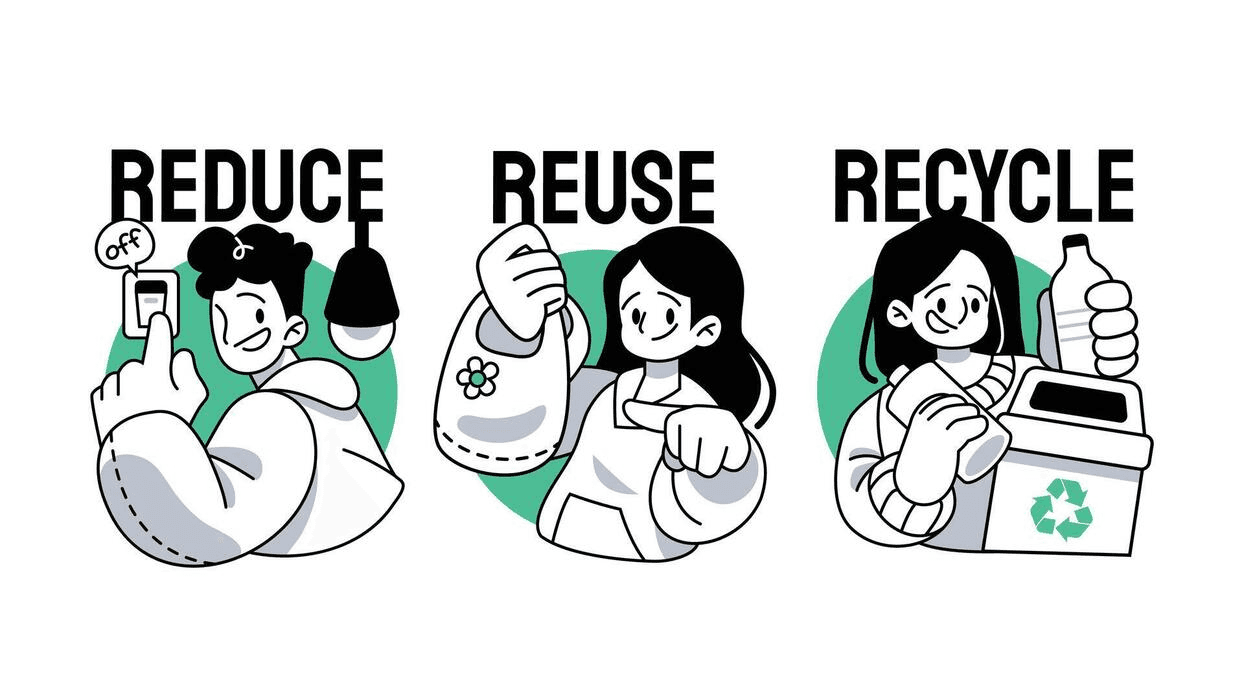
There's a reason the 3 R's are taught in schools around the world. They aren't just an environmental slogan — they're a hierarchy. A decision-making framework that, if followed in order, can dramatically reduce how much waste a household, a city, or a country produces.
The problem is most of us skip straight to the last one.
Recycling is important. But it was always meant to be the last resort — not the first response.
The order matters more than you think
Reduce. Reuse. Recycle. This sequence is intentional. Each step is more impactful than the one that follows it.
Reducing means the waste never exists in the first place. No production cost, no transport, no disposal problem.
Reusing means something already made gets a second (or third) life. No new resources consumed. No new waste generated.
Recycling means a used material is processed into something new. It requires energy, water, and infrastructure — but it's still infinitely better than landfill.
When we jump straight to recycling without considering the first two, we're solving the symptom and ignoring the cause.
Green Fact
Recycling one tonne of plastic saves approximately 5,774 kWh of energy — but producing one tonne less plastic in the first place saves even more.
R1: Reduce — the most powerful of the three
Reducing is about conscious consumption. It means asking, before you buy something: do I actually need this? Is there a version of this that produces less waste?
In practice, reducing looks like:
- Buying vegetables loose instead of pre-packaged
- Choosing products with minimal or recyclable packaging
- Saying no to single-use items — plastic bags, disposable cutlery, straws
- Buying in bulk to reduce the ratio of packaging to product
- Repairing appliances and clothing instead of replacing them
None of these are dramatic lifestyle changes. But collectively, they reduce the volume of material entering your home — and eventually, your bin.
Tip
The next time you're about to buy something, ask: will this create waste I can't easily dispose of? That one question changes purchasing habits faster than any rule.
R2: Reuse — giving things a second life
Reuse is the middle ground — and one of the most underrated habits in urban households. It means finding value in something before discarding it.
Glass jars become storage containers. Old newspapers become packaging material. Worn cotton shirts become cleaning rags. A cardboard box gets used for moving, storage, or a child's craft project before it ever sees a recycling bin.
Reuse also extends to buying second-hand — furniture, electronics, books, clothing. Every pre-owned purchase is one less new item manufactured and one less old item discarded.
80%
of products are discarded after single use
2x
longer product life = 50% less waste
₹0
cost of reusing a glass jar
In Indian households, reuse has always been embedded in culture — dabba culture, using old saris as dusters, keeping biscuit tins as storage. The practice isn't new. It just needs to be intentional.
R3: Recycle — the essential backstop
When you can't reduce, and you can't reuse, recycling is where materials get a second chance at life.
But recycling only works when the right materials arrive at the right facilities in a usable condition. This is where segregation becomes critical — and where Green3r's daily pickup system plays a direct role.
When you separate your dry waste correctly:
- Paper and cardboard go to paper mills and become new packaging or stationery
- Plastic bottles and containers are processed into fibres, furniture, or new packaging
- Glass is melted down and remoulded indefinitely without quality loss
- Metal tins and cans are among the most efficiently recycled materials on earth
Green Fact
Aluminium can be recycled infinitely without losing quality. Recycling one can saves enough energy to run a television for three hours.
When mixed waste arrives at a facility, sorting becomes labour-intensive and incomplete. Much of it ends up in landfill not because it couldn't be recycled — but because it arrived contaminated.
Your bin habits determine what's actually possible downstream.
How Green3r supports all three R's
Green3r is built around making the third R — recycling — as frictionless as possible. But the platform also nudges the first two.
By tracking your pickups and showing your impact over time, the Green3r app makes waste visible. And when waste becomes visible, consumption habits follow.
Segregating daily into wet and dry waste is the foundation. The underlying goal is a city where less goes to landfill — not because of better technology alone, but because residents are more deliberate about what they bring home and how they send it out.
Reduce what you bring in. Reuse what you already have. Recycle what remains. In that order, every time.
It's not a perfect system. But it's a dramatically better one — and it starts at your doorstep.
🌱 Green3r App
Start your waste management journey with Green3r
Download on iOS & Android · Delhi NCR & nearby cities